SERVICE REQUEST?
Fill out the form below.
Find our nearest location
Your Local Office

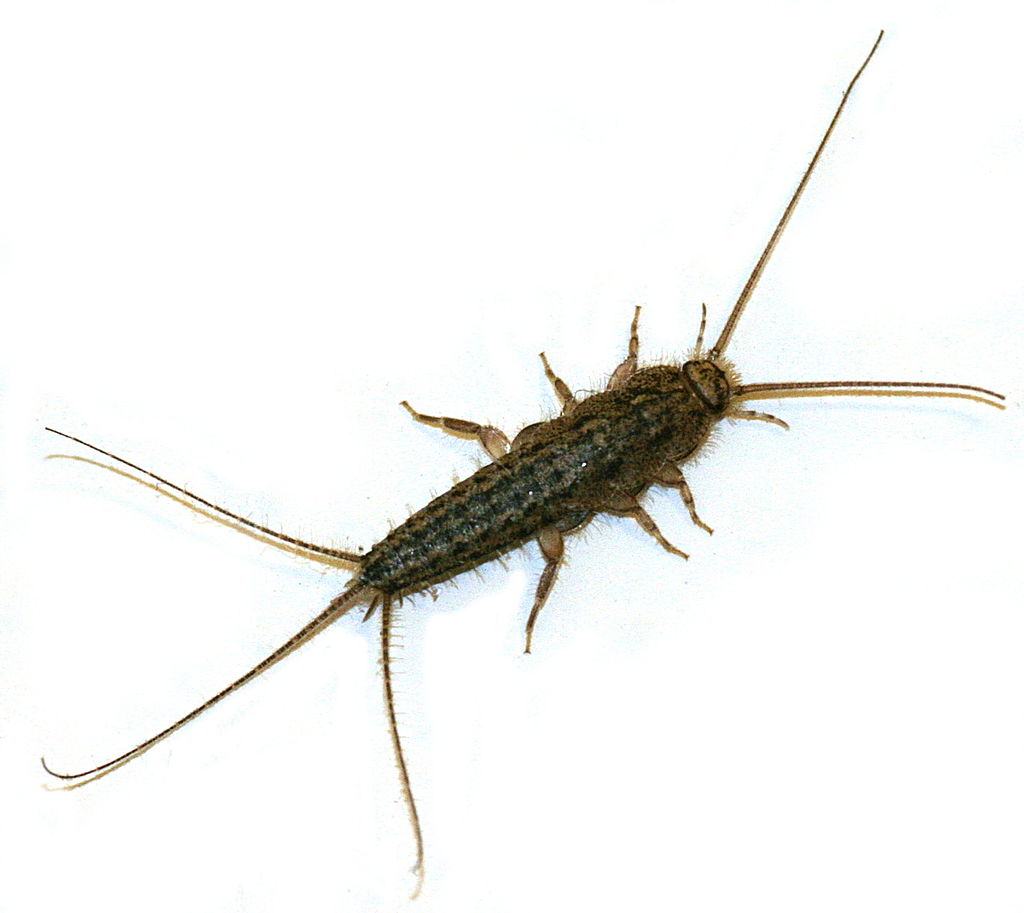
Firebrat
Attribution: Paethon [GFDL or CC-BY-SA-3.0-2.5-2.0-1.0], via Wikimedia Commons
Size:
Up to ½-inch
Color:
May appear slightly silvery but is usually mottled with patches of light and dark scales.
Behavior:
Firebrats are a type of silverfish and have many of the same habits. Their biologies are similar as well. With quick movements, they dart rapidly to a crack when lights are turned on. Their bodies are flattened which enables them to hide in very small cracks or crevices, even within the confines of narrow book bindings, the loose pages of books, or in the corrugations of cardboard. Unlike most other insects, silverfish and firebrats develop without metamorphosis. The newly hatched silverfish nymphs look like tiny adults except that they do not possess the characteristic body scales found on larger nymphs and adults. Firebrats are scavengers and feed on molds, dead insects and other organic debris. They also will infest and attack stored food products, particularly stored oats and similar grain products, especially if the food is moist and has some molds. Firebrats are also known to be pests of old books and will feed on the pages. They also may feed on and damage wallpapers. They are extremely resistant to starvation and may be kept alive in a glass jar without food and water for weeks.
Firebrats prefer warmer temperatures; therefore they are often found near sources of heat such as furnaces, water heaters, in boiler rooms, etc. They are able to survive in drier conditions than most insects. For example, they have been found living in attics where temperatures have been known to reach 130°F and where the relative humidity is very low.
Firebrats can be very difficult to control. Efforts should be focused in areas which stay quite warm, although firebrats can be found throughout a home or building. In addition, firebrats often live in the soffits and behind the fascia board behind gutters. Individual firebrats then invade the interior of the home from this “reservoir” site. Blown-in insulation compounds the problem because it prevents a professional from safely venturing into the attic to look for active harborages. A pest control professional should be consulted when firebrats are a regular problem. Areas that may require attention and possible treatment include:
- Furnace rooms, boiler rooms, etc.
- Voids where plumbing is located.
- Voids behind electrical outlets.
- Molding around windows and doorways.
- The attic, crawl space and basement.
- The soffits.
Family Name:
Thermobia domestica
Read What Our Clients
Are Saying
Zach H is the bomb! Great customer service! Handle my problem superior. I was freaking out I’m terrified of mice/rats and Zach made me comfortable and confident that Terminix will get the job done over all the other pest companies call “Zach Attack at Teminix!”👍🏾
Incredible customer service. Thorough and professional!
Very attentive work with excellent customer service and performance!
Mr. Thomas was amazing! He explained everything that he was doing and was very nice.
Ronaldo (Thomas) was amazing! He goes above and beyond ever service!
Quenton, is a great technician did a thorough job.
Very satisfied with their service.
Super friendly and dedicated to quality customer service!
Do you professional and his business quite well?nAnd very respectful of the property
Ronaldo provides exceptional service. I recommend his customer service
Ronaldo Thomas did a great job. Thank you sir for taking your time and not rushing great service
Daniel MainsHe was very well informed and kind. Made the process easy and stress free.
SERVICE REQUEST?
Fill out the form below.