SERVICE REQUEST?
Fill out the form below.
Find our nearest location
Your Local Office

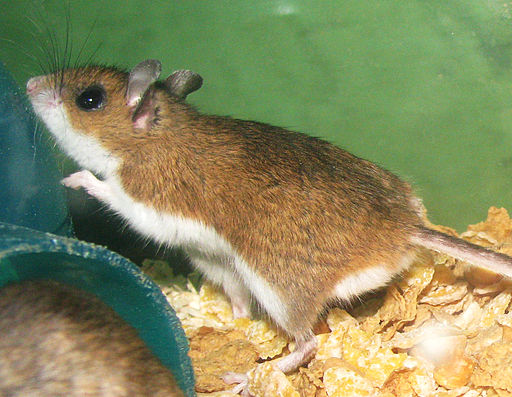
Deer Mouse
Attribution: 6th Happiness, [CC-BY-SA-3.0], via Wikimedia Commons
Size:
Body is up to two inches in length.
Color:
This species has several closely related cousins that are colored similarly. All species are bicolored — the top is light brown to red-brown and the feet and underbelly are pure white.
Behavior:
Unlike the house mouse, the deer mouse is not found in cities but is associated more with rural areas and buildings located in or near wooded areas. It does not commonly invade homes, but in rare instances one or more deer mice may invade a particular building. The deer mouse is a medically important species because it carries the hantavirus. This virus can result in serious, often fatal, respiratory disease in humans. Cases of hantavirus are rare — only about 300-400 cases have been documented in the past nine years, and most have been in the Western United States. The hantavirus can be contracted in a number of ways: by handling dead, infected deer mouse carcasses; by breathing in mouse-urine-laden dust particles that contain the virus; or by inhaling dust from areas of accumulated deer mouse droppings. You should avoid any area where infected deer mice have frequented unless wearing proper protective gear.
Deer mice prefer the outdoors where they nest in tree holes, hollow logs, under logs and in piles of stones, branches or logs. If inside, they are most often found in areas of a home where the least human activity occurs, such as attics, garages, basements and crawl spaces.
If you live in an area where deer mice have been seen or could be present, it may be prudent and desirable to hire an experienced professional to control the mice. Proper precautions should be taken to minimize any possible health risk. Remember, the risk of actually encountering hantavirus-infected deer mice is very remote, but taking the following steps can minimize any potential risk:
- Never sweep or vacuum mouse droppings and dust or debris in mouse activity areas.
- Wear a respirator equipped with a High Efficiency Purifying Air (HEPA) filter as well as unvented protective goggles, and impermeable latex or rubber gloves.
- Soak mouse droppings and dusty areas with an EPA-registered disinfectant then wipe up with paper towels. Place the soiled towels in a sealed plastic bag and dispose in an outdoor trash receptacle.
- Clean protective equipment with the EPA-registered disinfectant, then again with soap and water, and allow to air dry before the next use.
- Spray dead deer mice with EPA-registered disinfectant before disposal. Handle traps wearing protective latex or rubber gloves and a HEPA-equipped respirator. Try to avoid touching or handling the carcass. Dispose of the carcass in a sealed plastic bag in an outdoor trash receptacle.
Family Name:
Peromyscus maniculatus
Read What Our Clients
Are Saying
Isaiah Langlais thank you, you always take care of our property when you come.
Incredible customer service. Thorough and professional!

Ronoldo thomas was both courteous and professional he took care of the inside and the outside of our home he was friendly. He explained everything that he was doing, and he was respectful of both my home and my time.
Very professional and through service
Ronaldo provides exceptional service. I recommend his customer service
Ronaldo Thomas did a great job. Thank you sir for taking your time and not rushing great service
Very detail in his instructions and polite.
Ronaldo (Thomas) was amazing! He goes above and beyond ever service!
Mr. Carl Quick is my terminix at Morty Pride Meats. He is a wonderful person. He does a very good job. He is a respectful person and a friendly person. He is great. I would recommend him to anyone.
Super friendly and dedicated to quality customer service!
Very, very, very good customer service! Anthony Parker is a great representative and he is very well informed. I highly recommend!!!
Quenton, is a great technician did a thorough job.
SERVICE REQUEST?
Fill out the form below.