SERVICE REQUEST?
Fill out the form below.
Find our nearest location
Mice Pest Control Services for NC & VA Homes
When it comes to the right choice to get rid of mice in your home, Terminix® is your ultimate mouse exterminator.
Mice may seem small, but the damage they create inside a home can grow quickly—from contaminated food and chewed wiring to hidden nests in attics, crawl spaces, and wall voids. If you are seeing droppings, hearing scratching sounds, or noticing signs of activity, professional pest control for mice can help stop the problem before it spreads. With trusted Terminix mouse control, homeowners across NC and VA can get targeted inspection, treatment, and exclusion support designed for lasting protection.

Why Mice Are More Than a Nuisance — Health Risks for NC & VA Households
Mice are dangerous because they can contaminate food, spread disease through droppings and urine, trigger allergies, and damage wiring, insulation, drywall, and stored belongings. A small mouse problem can quickly become a larger health and property risk, which is why fast pest control for mice is important.
Mice are not just an inconvenience in the pantry or attic. In North Carolina and Virginia homes, they can create real health concerns when they move through kitchens, crawl spaces, garages, wall voids, and storage areas.
This is why a fast, professional response to any signs of mouse activity is essential, especially in homes with children, elderly residents, or immunocompromised family members.
How Do Mice Enter Your Home? Common Entry Points in NC & VA Houses
Mice can enter your home through any gap or crack larger than ¼ inch, approximately the diameter of a pencil. Common entry points include foundation cracks, gaps around pipes, worn door weatherstripping, damaged roof vents, crawl space vents, and garage door seals.
Because mice are small, flexible, and persistent, they often enter through openings homeowners overlook. In Eastern NC, homes can be especially vulnerable because humidity, aging materials, and seasonal weather changes may cause wood shrinkage, warping, or small gaps around doors, windows, and exterior trim.
Common mouse entry points include:
- Foundation cracks, weep holes, and small gaps around the slab or crawl space.
- Openings where pipes, cables, conduit, or HVAC lines enter the home
- Gaps around doors and windows where weatherstripping has worn down
- Roof vents, soffit gaps, and chimney openings that allow attic access
- Garage door seals, especially damaged bottom rubber seals
- Crawl space vents with missing, loose, or damaged screens
- Utility penetrations through exterior walls
- Small gaps beneath siding, trim, or brick transitions
A trained mouse exterminator looks for these access points during inspection because eliminating mice without sealing the entry points often leads to repeat activity.
Our Terminix mouse control technicians inspect these common entry areas during your free inspection and can seal them as part of our exclusion service, helping prevent new mice from entering after treatment.
MOST COMMON MICE

HOUSE Mouse
House mice are easily recognizable by their small size and grey to light brown color. They nest in hidden areas of the home, like attics, basements, and inside wall voids. What makes them particularly troublesome is their ability to reproduce rapidly–meaning a small problem can quickly escalate into a full-blown infestation if left unchecked.
Deer Mouse
Deer mice are more commonly found in rural areas and can be recognized by their brown bodies and white underbellies. While they typically live outdoors, they may enter homes during the colder months in search of warmth. These mice are also known carriers of hantavirus, which makes them a particular health concern if they find their way inside.


WHITE-FOOTED Mouse
White-footed mice are similar to deer mice and are commonly found in wooded areas. However, during the fall and winter, they may move indoors in search of warmth, often nesting in basements, sheds, and garages. Like deer mice, they pose similar health risks, including the potential to carry diseases such as hantavirus.
Types of Mice Found in NC & VA Homes
|
Species |
Size |
Color |
Common Location |
Primary Risk |
Treatment Method |
|---|---|---|---|---|---|
|
House Mouse |
2.5–4 inches long, excluding tail |
Gray to light brown |
Kitchens, wall voids, attics, basements, pantries |
Food contamination, rapid reproduction, droppings |
Traps, bait stations, exclusion, and sanitation guidance |
|
Deer Mouse |
3–4 inches long, excluding tail |
Brown body with white belly |
Rural homes, garages, sheds, crawl spaces |
Hantavirus concern |
Careful inspection, protected cleanup, targeted trapping |
|
White-Footed Mouse |
3–4 inches long, excluding tail |
Brownish body with white feet and underside |
Wooded areas, basements, sheds, garages |
Hantavirus concern and tick-related disease ecology |
Species-aware treatment, exclusion, and monitoring |
A female house mouse can produce 5–10 litters per year with about 5–6 pups per litter, meaning a small issue can grow quickly. A single mouse may also produce 50–75 droppings per day, which is why early mouse pest control is so important.
SPOTTING A MOUSE INFESTATION

Look for these signs of a mouse infestation:
How Our Mouse Extermination Service Works — Step by Step
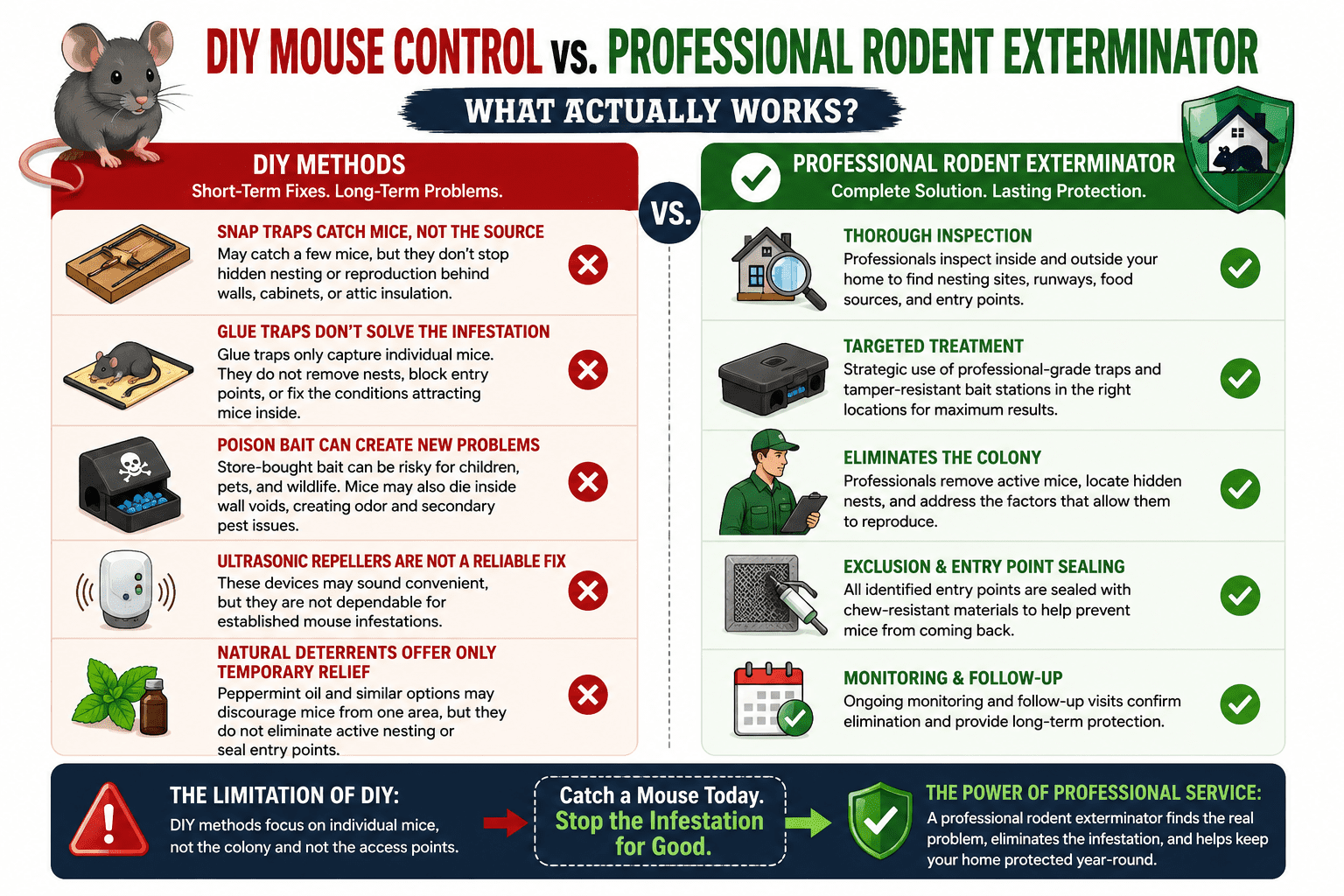
Professional mouse control works by identifying the species, locating nesting areas, eliminating active mice, sealing entry points, and monitoring for new activity. This full process is what separates professional pest control for mice from short-term DIY trapping.
A certified technician inspects the full property, including the attic, crawl space, basement, garage, kitchen, wall voids, pantry areas, and exterior perimeter. During the inspection, we look for droppings, gnaw marks, grease trails, tracks, nests, odors, and access points.
Different mice require different approaches for effective control. House mice typically respond well to snap traps or tamper-resistant bait stations placed along their active runways. In contrast, deer mice and white-footed mice require extra caution due to potential hantavirus exposure. Every Terminix mouse exterminator completes specialized training in rodent biology and behavior. This training includes proper safety protocols and techniques for handling deer mice and white-footed mice in North Carolina and Virginia, ensuring that each removal is both safe and effective.
Treatment may include snap traps, tamper-resistant bait stations, and glue boards placed in strategic locations. Interior treatment focuses on runways, which are the paths mice repeatedly use along walls, behind appliances, near cabinets, and inside hidden spaces. Bait stations are placed in areas that are inaccessible to children and pets.
Once entry points are found, they are sealed with chew-resistant materials such as steel wool packing, copper mesh, hardware cloth, and exterior-grade sealants. This is one of the most important parts of professional mouse pest control because it helps prevent re-infestation.
Monitoring devices are placed in key areas to confirm whether mouse activity continues. Follow-up service helps verify elimination, check for new signs, and remove deceased rodents when needed. If mice return between scheduled visits, we come back at no extra charge.
DIY Mouse Traps vs. Professional Rodent Exterminator — Which Mouse Control Method Actually Works?
Choosing the right pest control for mice is the difference between temporarily catching a few rodents and fully eliminating the infestation from your home.
Where Do Mice Nest in Your House? Common Hiding Spots
Mice usually nest close to food, often within about 30 feet of a reliable food source. In homes, they prefer quiet, dark, protected spaces where they can stay hidden while accessing crumbs, pantry items, pet food, or moisture.
Common nesting areas include:
- Inside wall voids near kitchens
- Inside attic insulation
- Behind refrigerators, stoves, and dishwashers
- Beneath kitchen cabinet kickboards
- Inside stored boxes in garages or basements
- In cluttered closets, sheds, and outbuildings
- Inside old furniture, fabric, or insulation
- Around crawl space insulation or vapor barrier edges
A mouse nest often looks like a loose ball of shredded paper, fabric, insulation, cardboard, or plant material. It may be about the size of a baseball or softball. A strong musky, ammonia-like smell can also point to an active nesting area.
If you find a mouse nest, do not disturb it with your bare hands. In areas where deer mice or white-footed mice may be present, improper cleanup can increase health risks. Call a professional for safe removal.
How Long Does It Take to Get Rid of Mice?
A moderate mouse infestation in a standard home typically requires multiple professional service visits over several weeks. Larger infestations or homes with multiple structural entry points may need ongoing treatments and monitoring. Exclusion is the critical step that helps prevent mice from returning.
The timeline depends on the size of the infestation, how many nesting areas are present, whether mice have entered wall voids or attic spaces, and how many entry points need to be sealed. Homes with crawl spaces, attached garages, heavy clutter, or older exterior gaps may need more detailed service.
The goal of Terminix mouse control is not just to remove visible mice. It is to eliminate active activity, reduce attractants, seal access points, and monitor for new signs.
Terminix® is Mouse Control Made Easy
All it takes is one phone call to our headquarters to set up your free inspection. We’ll send a certified mouse exterminator from our team to your home to evaluate and recommend the best way to get rid of mice for you.
Once you approve our plan, we’ll get to work with our proven mouse control systems to get rid of mice in your home and let you sleep better at night knowing your space is free of these destructive rodents. Our approach also follows Integrated Pest Management (IPM) principles, focusing on inspection, targeted treatment, exclusion, monitoring, and long-term prevention to help reduce future mouse activity. And we back our initial and follow-up treatments with a 100% money back guarantee.
To learn more about our mouse control methods to help you get rid of mice, call 1-800-BUGS-911 (800-284-7911) to schedule a free initial consultation today, or use our location finder to find your nearest office!
Proudly serving customers in Fayetteville, Elizabeth City, Wilmington, Raleigh, New Bern, Goldsboro, Cary and Durham, NC as well as Virginia Beach, Chesapeake, Newport News and Smithfield, VA.
FAQs
How do mice get into your house?
Mice enter through small cracks, gaps, vents, utility openings, and worn door seals. They can squeeze through openings as small as ¼ inch, which means even pencil-sized gaps can become entry points.
What are the signs of a mouse infestation in your home?
Common signs include droppings, scratching sounds, gnaw marks, grease trails, nests, musky odors, damaged food packaging, and unusual pet behavior near walls, cabinets, or appliances.
How long does it take to get rid of mice?
Most moderate infestations can be controlled within a few weeks with professional service. Severe infestations or homes with multiple access points may require additional follow-up visits.
Is pest control for mice safe for my pets and children?
Yes, professional service is designed with safety in mind. Tamper-resistant bait stations and strategic placement help keep treatment materials away from children and pets while targeting mouse activity.
How much does pest control for mice cost?
The cost depends on the size of the home, infestation severity, number of entry points, and whether exclusion work is needed. A free inspection helps determine the right treatment plan.
Can mice come back after treatment?
Yes, mice can return if entry points remain open or food sources are available. That is why exclusion, sanitation guidance, and follow-up monitoring are important parts of lasting mouse control.
If you’ve seen droppings, heard scratching, or found damage in your pantry, attic, garage, or crawl space, don’t wait for the problem to grow. Schedule your free inspection today and let a trusted mouse exterminator help protect your home with professional pest control for mice built for lasting results.
Read What Our Clients
Are Saying
Ronaldo provides exceptional service. I recommend his customer service

Super friendly and dedicated to quality customer service!
Very professional and through service
Quenton, is a great technician did a thorough job.
Ronaldo Thomas did a great job. Thank you sir for taking your time and not rushing great service
Daniel Mains did a fantastic job. He was very informative and friendly.
Ronoldo thomas was both courteous and professional he took care of the inside and the outside of our home he was friendly. He explained everything that he was doing, and he was respectful of both my home and my time.
Isaiah Langlais thank you, you always take care of our property when you come.
Ronaldo (Thomas) was amazing! He goes above and beyond ever service!
Great job very thorough I am completely satisfied.
Incredible customer service. Thorough and professional!
Mr. Cunningham did an excellent job. I believe that is an asset to Terminix. Thank you for a job well done
SERVICE REQUEST?
Fill out the form below.