The smoky brown cockroach vs American cockroach comparison usually comes down to color, size, markings, and where the roach was found. Smoky brown cockroaches are usually smaller, uniformly dark brown, and more closely tied to humid outdoor spaces. American cockroaches are larger and reddish-brown, with a pale yellow marking behind the head.
Both can enter homes, and both should be taken seriously. Correct identification helps determine whether the problem is starting outdoors, near mulch, trees, and rooflines, or indoors, near drains, crawl spaces, basements, and plumbing.
Table of Contents
Smoky Brown Cockroach vs American Cockroach: Key Differences
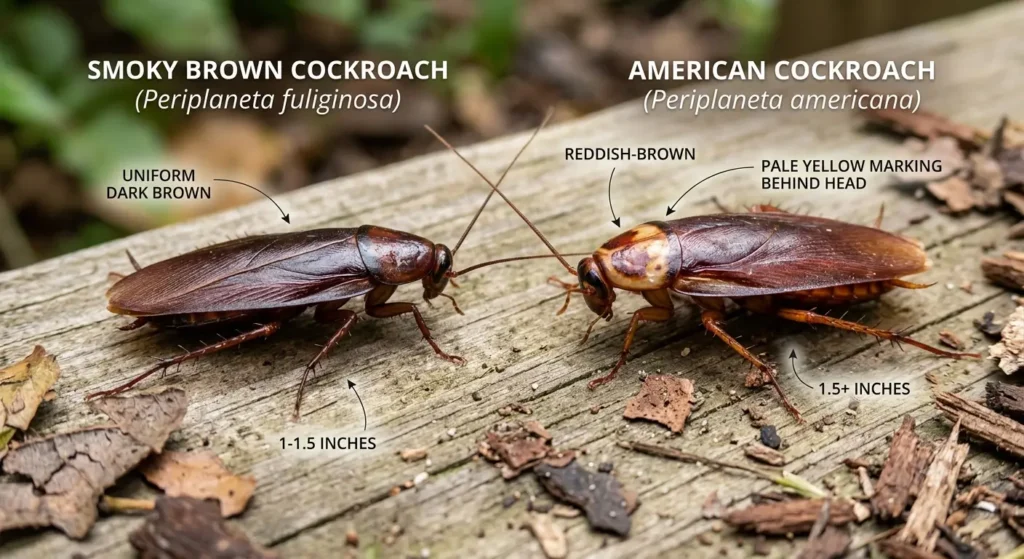
At first glance, these two roaches look similar. A closer look gives homeowners several useful clues.
Size, Color, and Markings
Smoky brown cockroaches are typically about 1 to 1.5 inches long and have a uniform dark brown to mahogany color. Texas A&M AgriLife notes that smoky brown cockroaches require high humidity and are often found outside in shaded, moist areas.
American cockroaches are usually larger, often around 1.5 inches or more, and reddish-brown. The clearest identifying feature is the pale yellowish band or figure-eight marking behind the head. The University of Maryland Extension describes the American cockroach as reddish-brown with a pale band along the pronotum.
Movement and Flight
Smoky brown cockroaches are strong fliers and are often drawn toward exterior lights at night. They may appear near porch lights, windows, or upper-level entry points.
American cockroaches have wings but are more likely to run when disturbed. They are commonly associated with sewers, drains, basements, crawl spaces, and other warm, damp areas.
American Cockroach vs Smoky Brown: Quick Comparison
The easiest way to compare an American cockroach vs smoky brown cockroach is to look at color, markings, habitat, and entry points together. One clue may not be enough on its own, but the pattern usually tells you which species you are dealing with.
| Feature | Smoky Brown Cockroach | American Cockroach |
| Color | Uniform dark brown or mahogany | Reddish-brown |
| Markings | No distinct pale marking behind the head | Pale yellow marking behind the head |
| Typical size | About 1 to 1.5 inches long | About 1.5 inches or larger |
| Common habitat | Mulch, tree holes, leaf litter, woodpiles, shaded landscaping, and attics | Drains, sewers, basements, crawl spaces, utility rooms, and plumbing areas |
| Flight behavior | Strong flier and often attracted to exterior lights | Can fly, but more often runs when disturbed |
| Common entry points | Attic vents, roofline gaps, windows, damaged screens, and upper-level openings | Drains, pipe gaps, foundation cracks, door gaps, and utility openings |
| What indoor sightings may suggest | Outdoor activity nearby, moisture, or upper-level access points | Possible indoor harborage near plumbing, drains, or damp areas |
If the roach is uniformly dark and appears near lights, windows, or upper areas of the home, smoky brown cockroaches are more likely. If the roach is reddish-brown with a pale marking behind the head and appears near drains, basements, or plumbing, American cockroaches are more likely.
Where Do Smoky Brown Cockroaches Live?
Smoky brown cockroaches live mainly in warm, humid outdoor areas. They are common around shaded landscaping, tree holes, woodpiles, leaf litter, and mulch beds. The University of Florida describes them as abundant outdoors in tree holes, wood piles, attics, and other warm, moist places.
Around homes, they become a problem when moisture, clutter, and entry points line up. Leaky gutters, heavy mulch, dense vegetation against the house, and exterior lights can make the area more attractive.
Do Smoky Brown Roaches Infest Homes?
Smoky brown roaches do infest homes in some situations, but they are usually more outdoor-oriented than American cockroaches. They may enter through attic vents, roofline gaps, damaged screens, or openings around windows and doors.
Seeing one smoky brown cockroach indoors does not always mean there is a major indoor infestation. Repeated sightings, especially at night or in upper areas of the home, suggest there may be outdoor harborages nearby and entry points that need to be sealed.
Where Do American Cockroaches Live?
American cockroaches prefer warm, damp, dark spaces. They are often found in sewers, drains, basements, crawl spaces, utility rooms, and areas near pipes or water heaters.
Inside homes, American cockroach activity often points to moisture and access. Gaps around pipes, foundation cracks, floor drains, and loose door seals can give them a path indoors. If activity continues, the issue may be deeper than the roaches visible at night.
What Does a Smokybrown Cockroach Nymph Look Like?
A smokybrown cockroach nymph is smaller than an adult and does not have fully developed wings. Nymphs may appear darker, banded, or differently marked than adults, making identification harder.
Because young roaches change as they molt, location matters. Small roaches in mulch, leaf litter, or attic spaces may point toward smoky brown cockroaches. Small roaches near drains or damp indoor areas may point toward another species.
For a broader look at insect identification, Terminix’s blog on whether cockroaches are beetles explains how body shape, antennae, and wings can help separate roaches from common lookalikes.
Are Smoky Brown Cockroaches Dangerous?
Smoky brown cockroaches are not known for biting or stinging, but they can still create health and sanitation concerns. The same is true for American cockroaches.
Cockroaches can move through garbage, drains, decaying organic material, and other contaminated areas before crossing indoor surfaces. They can also leave droppings, shed skins, and allergens behind. For people with asthma or allergies, cockroach activity in the home can be especially concerning.
How to Get Rid of Smoky Brown Cockroaches
Smoky brown cockroach control usually starts outside. Because these roaches often live near the exterior before entering, focus on outdoor habitat, moisture, and entry points.
- Reduce Outdoor Hiding Places
Move woodpiles away from the home. Keep mulch thin and pull back from the foundation. Remove leaf litter, fallen branches, and piles of debris. Trim vegetation so it does not press against siding, windows, or rooflines.
- Control Moisture and Lighting
Repair leaky gutters, reduce irrigation overspray, and improve drainage around the foundation. Since smoky brown cockroaches are attracted to lights, consider switching bright white exterior bulbs near doors and windows to less attractive outdoor lighting.
- Seal Upper Entry Points
Inspect attic vents, roofline gaps, soffits, window screens, and door seals. Smoky brown cockroaches can fly to higher areas of the home, so control efforts should not focus only on the foundation.
How to Get Rid of American Cockroaches
American cockroach control focuses on interior moisture, food access, and ground-level entry points. If they are active indoors, the source may be near drains, crawl spaces, or plumbing.
- Remove Food and Water Sources
Clean grease, crumbs, and food residue from kitchens and storage areas. Store food in sealed containers and keep trash tightly covered. Repair plumbing leaks and reduce moisture in crawl spaces, basements, and utility rooms.
- Seal Ground-Level Entry Points
Caulk gaps around pipes, seal foundation cracks, add door sweeps, and repair damaged screens. Pay close attention to plumbing, utility lines, and drains.
- Use the Right Treatment Strategy
Spray treatments alone often miss hidden activity. A better approach includes inspection, exclusion, sanitation, moisture control, and targeted treatment. Terminix offers cockroach control services designed to identify the species, locate activity, and treat the problem at the source.
Key Takeaways
- The difference between the smoky brown cockroach and the American cockroach is easiest to spot by color and markings.
- Smoky brown cockroaches are uniformly dark brown and often tied to humid outdoor areas.
- American cockroaches are larger and reddish-brown, with a pale marking behind the head.
- Smoky brown cockroaches often enter through upper-level gaps, while American cockroaches often enter through drains, pipes, and foundation openings.
- Correct identification helps determine the right control plan.
Frequently Asked Questions
Should I be concerned if I only saw one large cockroach?
One large cockroach does not always mean there is a major infestation, but it should not be ignored. A single smoky brown cockroach may have flown in from outside, while an American cockroach may point to activity near drains, crawl spaces, or plumbing. If sightings continue, or if you see roaches in different parts of the home, schedule an inspection.
Why am I seeing cockroaches even though my house is clean?
Clean homes can still attract cockroaches if moisture, shelter, or entry points are available. Leaky pipes, clogged gutters, damp mulch, gaps around utility lines, and exterior lighting can all contribute to activity. Cleaning helps reduce food sources, but it does not always solve the underlying access or moisture problem.
Do store-bought sprays work on smoky brown or American cockroaches?
Store-bought sprays may kill visible roaches, but they often do not reach the source of the problem. Cockroaches hide in wall voids, drains, crawl spaces, mulch beds, and other protected areas. Sprays can also scatter activity if they are used in the wrong place. A better plan starts with identification, inspection, exclusion, sanitation, and targeted treatment.
What does it mean if I see cockroaches during the day?
Daytime activity can be a sign that roaches are being pushed out of hiding by crowding, moisture changes, or disturbance. It can also mean the harborage is nearby. One daytime sighting is not enough to confirm the size of the problem, but repeated daytime sightings should be taken seriously.
What should I check before calling a pest control professional?
Look for patterns. Note where you saw the roaches, what time of day they appeared, whether they were near drains or upper windows, and whether outdoor conditions changed recently. You can also check for leaks, damaged door sweeps, torn screens, heavy mulch, clogged gutters, and gaps around pipes or vents. These details help a technician narrow down the source faster.
How can I keep cockroaches from coming back after treatment?
Long-term prevention depends on reducing the conditions that attracted them in the first place. Keep food sealed, repair leaks, improve drainage, trim vegetation away from the home, remove debris, seal gaps, and monitor damp or dark areas. For smoky brown cockroaches, outdoor habitat reduction is especially important. For American cockroaches, plumbing, drains, and crawl spaces often need closer attention.
Conclusion: Get the Right Treatment for the Right Roach
The comparison between the smoky brown cockroach and the American cockroach is more than a matter of appearance. Each species has different habits, hiding places, and entry points. Treating the wrong source can allow the problem to continue.
If you are seeing large roaches regularly or noticing recurring activity, professional identification is the best next step. Terminix can inspect your home, identify the species, and recommend a targeted plan to help eliminate cockroaches.
To schedule service, contact Terminix today or visit the Terminix homepage to find help in your area.