Bats are often misunderstood. While they are nature’s pest controllers, keeping insect populations in check, a bat colony in your home can quickly turn into a serious problem. Homeowners in Eastern NC and Hampton Roads VA frequently ask: “How do I get rid of bats safely?” or “What to do if a bat is in your house?”
Finding bats in your attic, walls, or chimneys isn’t just a nuisance—it’s a health and legal concern. Improper removal can lead to rabies exposure, fungal infections, structural damage, and fines if attempted during bat control blackout periods.
This guide explains everything you need to know about bat removal from home, bat infestation signs, and why professional wildlife control bat services are critical.
Table of Contents
Blackout Season: Legal Protection & Timeline
During bat blackout season, female bats give birth and raise their young. Both North Carolina and Virginia enforce state wildlife laws protecting maternity colonies. Attempting to remove bats from a house during this period can result in fines and legal penalties.
| State | Blackout Period | Allowed Actions | Prohibited Actions |
| NC | May 1 – July 31 | Pre-season inspection (March–April), monitoring | Disturbing or removing roosting bats |
| VA | May 1 – Aug 15 | Pre-season inspection, monitoring | Disturbing or removing roosting bats |
Legal Callout: Attempting to remove bats during the blackout period is illegal in NC & VA. Only professional exclusion outside this window is safe and lawful.
Tip: Pre-season exclusion (March–April) allows you to seal potential entry points before maternity season begins, minimizing risk and ensuring humane removal.
Common Bat Species in NC & VA Homes
Knowing which bats are likely in your home improves your ability to respond safely.
Big Brown Bat
- Size & Appearance: 4–5 inches wingspan, robust brown body
- Roost: Attics, wall voids, chimneys
- Activity: Year-round
- Notes: Most common attic-roosting species; highly adaptable
Little Brown Bat
- Size & Appearance: 3–4 inches wingspan, smaller brown body
- Roost: Attics, often in large colonies
- Activity: Seasonal; populations declining due to white-nose syndrome
- Notes: Heavily protected; legal removal only outside blackout season
Eastern Small-Footed Bat
- Size & Appearance: 2–3 inches wingspan, dark brown
- Roost: Rock crevices, sometimes structures
- Activity: Transitional seasons
Tri-Colored Bat
- Size & Appearance: 3–4 inches wingspan, tri-colored fur
- Roost: Seasonal structures
- Activity: Spring & fall
Health Risks: Guano, Rabies & Histoplasmosis
Bats pose more than a nuisance—they carry serious health risks:
- Rabies: Primary vector in NC & VA; exposure requires immediate medical consultation even if no bite is visible.
- Histoplasmosis: Lung infection caused by fungal spores in guano; at-risk populations include immunocompromised homeowners and attic cleaners without PPE.
- Guano accumulation: Contaminates insulation, causes odors, and attracts insects. Cleanup should only be handled by professionals.
Emergency Tip: If you find a bat in your living space, isolate it, avoid touching it, and call wildlife control immediately.
How Bats Get Into Homes
Bats can squeeze through gaps as small as 3/8 inch. Common entry points include:
- Ridge vents & roof vents
- Chimney flashing & chimney caps
- Warped or rotted fascia board gaps
- Soffit and eave gaps
Professional one-way exclusion devices ensure bats exit but cannot re-enter, making permanent removal safe and legal.
Got Bats? Signs of an Infestation
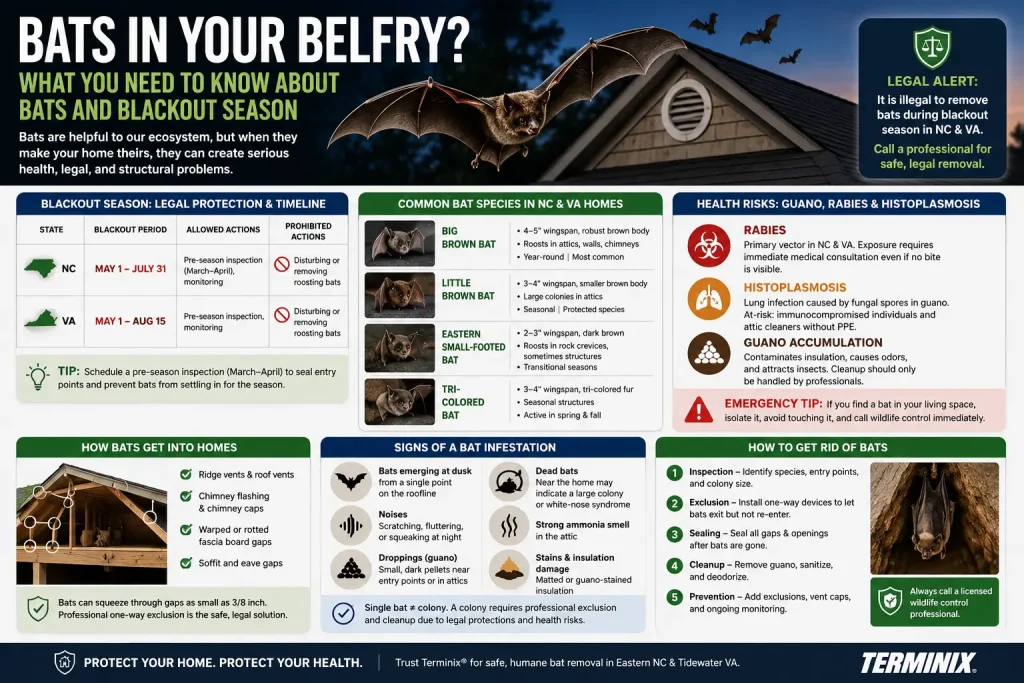
Early detection is critical to prevent structural damage, health risks, and prolonged infestations. While noises, droppings, and stains are common indicators, there are several additional high-value signals that homeowners in Eastern NC and Hampton Roads VA should watch for:
- Bats emerging at dusk from a single point on the roofline: This is often the most definitive sign of a colony. Observe the roofline just after sunset; consistent emergence from the same spot indicates an established group rather than a lone bat.
- Dead bats near the home: Finding deceased bats in your yard or near entry points can indicate a large colony or issues such as white-nose syndrome, which affects local populations.
- Strong ammonia smell in the attic: Accumulated guano produces a pungent odor that is often the first sign homeowners notice before bats are seen or heard.
- Visual inspection of attic insulation: Matted, guano-stained, or contaminated insulation indicates long-term roosting and may suggest a sizable colony has been present for months or years.
- Noises: Scratching, fluttering, or squeaking sounds—especially at night—suggest active bats. Pay attention to patterns and volume, which can indicate colony size.
- Droppings (guano): Small, dark pellets accumulate near entry points and in attics. Larger quantities signal longer-term infestations.
- Stains: Oily marks near vents, soffits, or chimneys indicate regular bat traffic in and out of the home.
Important distinction: A single bat that accidentally enters your home is not the same as an established colony. Single bats can often be managed with minor precautions and safe capture, whereas colonies require professional exclusion and cleanup due to legal protections, health hazards, and the risk of structural contamination.
How To Get Rid Of Bats
While bats can be beneficial to have around, they can also become a nuisance if they roost in your home or business. Here are a few ways to get rid of bats:
- Install bat houses: If you want to encourage bats to roost elsewhere, consider installing bat houses on your property. Bat houses provide a safe and comfortable roosting spot for bats, and they can help keep bats out of your home. If there’s a problem with a roosting site, the females will carry their young to a new one. If you decide to go the bat house route, you don’t want to install them on the side of your home.
- Seal entry points (exclusion): Bats can squeeze through even the tiniest of gaps, so it’s important to seal all entry points to your home or business. Use caulk, weatherstripping, or mesh to seal gaps around windows, doors, and vents. These areas should never be sealed without a devise that would allow the bats to leave so that they are not trapped inside, this could lead to a multitude of problems including them finding their way into the home trying to get out. Exclusion cannot be performed during blackout season.
- Turn off exterior lights: Bats are attracted to light, so turning off exterior lights can help deter them from roosting near your home.
- Contact a wildlife control expert: If you have a bat infestation, it’s best to leave the removal to the professionals. A wildlife control expert can safely and humanely remove bats from your home or business and help prevent future infestations.
Post-Removal Cleanup & Remediation
Once bats are excluded:
- Protective equipment is essential due to histoplasmosis risk
- Remove contaminated insulation, sanitize surfaces, and replace insulation
- Eliminate odors to prevent new colonies from returning
Professional wildlife remediation services ensure the home is fully safe and ready for occupancy.
Professional Bat Removal: What to Expect
When DIY isn’t enough, Terminix provides full-service, safe, and legal bat removal from the home:
Inspection
- Identify roost locations, colony size, and all entry points
Exclusion
- Install one-way devices to allow bats to exit but not return
- Only performed outside blackout season
Sealing
- Permanent gap sealing after all bats have exited
Follow-Up
- Technicians return to confirm no re-entry
- Monitor for stragglers and new gaps
This process ensures that even persistent bats are handled safely and effectively.
Timeline: Blackout Season Compliance
| State | Month | Actionable Steps | Prohibited Actions |
| NC | March–April | Pre-season inspection & gap sealing prep | — |
| NC | May–July | Observe but do NOT disturb roosts | Removal or exclusion of roosting bats |
| VA | March–April | Pre-season inspection & gap sealing prep | — |
| VA | May–Aug | Observe but do NOT disturb roosts | Removal or exclusion of roosting bats |
Choose Terminix For Safe, Humane Bat Control Services
When it comes to wildlife control, Terminix is the name you can trust. Our team of wildlife control experts has the knowledge and experience to safely and humanely remove bats from your home or business. We use the latest technology and methods to ensure that your bat problem is resolved quickly and efficiently.
Bats can admittedly be interesting creatures, they can also become a nuisance during their blackout season. If you have a bat infestation, it’s important to take action to get rid of them safely and humanely. By following the tips in this article and contacting the wildlife control experts at Terminix, you can ensure that your bat problem is resolved quickly and efficiently (see note below concerning blackout season).*
Schedule your free wildlife inspection with Terminix today!
Key Takeaways
- Early detection is critical: Recognize bat infestation signs like dusk emergence, guano accumulation, odors, and attic insulation damage.
- Know the blackout period: NC (May 1–July 31) and VA (May 1–Aug 15) protect maternity colonies; avoid DIY removal during this time.
- Species matter: Big brown and little brown bats are most common in homes; knowing species helps determine safe removal strategies.
- Health risks exist: Guano can lead to histoplasmosis, and bats can carry rabies—professional handling is recommended.
- Entry points: Bats enter via vents, chimneys, soffits, and fascia gaps; even tiny cracks (3/8 inch) can allow access.
- Professional removal is safest: Terminix provides inspection, one-way exclusion, sealing, and follow-up to ensure legal, effective, and humane control.
Endnote
Bats are essential to the ecosystem, but when they roost in your home, they become a legal, health, and structural concern. By recognizing bat infestation signs, understanding the bat blackout period, and acting at the right time—either through safe home precautions or professional bat removal from home—homeowners in Eastern NC and Hampton Roads VA can protect their family and property. Combining vigilance, preventive measures, and professional expertise ensures that bats are safely excluded while minimizing risk to humans and pets.
FAQs
Can I legally remove bats from my home myself?
Only outside the blackout period, using proper one-way exclusion devices; DIY removal during maternity season is illegal.
How do I know if I have bats in my attic?
Look for droppings, noises, bats emerging at dusk, and guano-stained insulation.
Are bats dangerous to humans?
Most bats are not aggressive, but they may carry rabies. Avoid contact and consult a doctor if exposed.
How much does bat removal cost?
Costs vary by colony size, exclusion complexity, and cleanup required; professional assessment provides accurate estimates.
When do bats come out at night?
Typically at dusk, shortly after sunset, to hunt insects.
What to do if a bat is in your house?
Isolate the bat, avoid direct contact, and call a professional immediately.
What is the bat control blackout period?
The legally protected maternity season when bats cannot be disturbed: NC May 1–July 31, VA May 15–Aug 15.
Can I clean guano myself?
No; professional cleanup is required due to histoplasmosis risk.
How do bats get into my house?
Through ridge vents, chimneys, fascia gaps, soffits, and eaves—any opening as small as 3/8 inch.
Ready to protect your home? Contact Terminix Wildlife Control today for a professional bat removal assessment and safe, legal exclusion services.