SERVICE REQUEST?
Fill out the form below.
Find our nearest location
Your Local Office

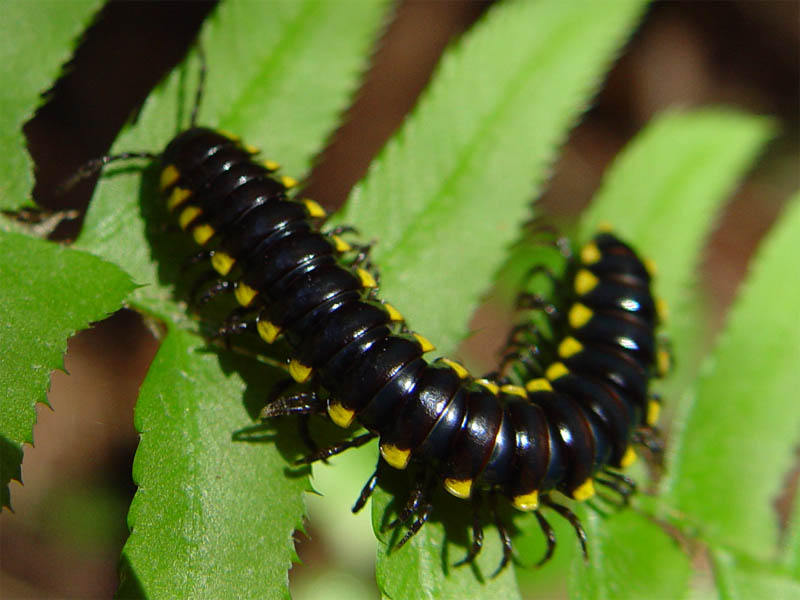
Millipede
Attribution: Franco Folin, [GFDL, CC-BY-SA-3.0 or CC-BY-2.5], via Wikimedia Commons
Size:
Generally small, about two inches or less in length. Some forest species in the southeastern United States may grow to four or more inches.
Color:
Brown or black.
Behavior:
Millipedes live in moist vegetation, leaf litter, and mulch. They feed upon decaying organic matter found in these areas. Millipedes are distinguished from centipedes in that they have two pairs of legs per body segment, while centipedes have only one pair of legs per body segment. Although dozens of millipedes may be found outside buildings, few may wander inside. If they do, millipedes usually die very quickly due to lack of moisture. They can, however, survive indoors in moist basements and crawl spaces. Under the right conditions, millipede “migrations” can occur. Where considerable amounts of decaying organic matter are found, such as thick leaf litter under trees or thick thatch layers in lawns, thousands of millipedes might be produced. If the area where they live dries out, becomes too wet, or the millipede population grows too large, a migration may occur. Thousands of millipedes begin crawling in search of better living conditions. In a few cases, hundreds of thousands of millipedes are present. In such cases, keeping all millipedes out of a building is likely impossible. Treatments can help minimize the numbers, however.
Outdoors, millipedes are found in leaf litter, landscape mulch, lawns, and under items in contact with the ground. Indoors, millipedes may survive in moist areas of garages, crawl spaces, and basements.
The following actions will help in controlling millipedes:
- Reduce potential breeding sites and harborages next to and near the building.
- Keep mulch and heavy vegetation, such as ivy, away from the foundation.
- Seal cracks and holes in the home s exterior to prevent millipedes from entering.
- Millipede migrations may require repeated treatments to the exterior and to cracks in the outside of the affected building.
- Determine the area where millipedes are originating and remove the material in which they are breeding (e.g., leaf litter, mulch), if possible.
Remember that total elimination of millipedes indoors may be impossible – especially when huge numbers are involved. Professional treatment, sealing cracks and holes, and removing breeding material should greatly reduce the numbers of millipedes.
Family Name:
Class Dilopoda
Read What Our Clients
Are Saying
Mr. Carl Quick is my terminix at Morty Pride Meats. He is a wonderful person. He does a very good job. He is a respectful person and a friendly person. He is great. I would recommend him to anyone.
Very detail in his instructions and polite.
Ronaldo (Thomas) was amazing! He goes above and beyond ever service!
Very professional and through service
Isaiah Langlais thank you, you always take care of our property when you come.
Super friendly and dedicated to quality customer service!
Ronoldo thomas was both courteous and professional he took care of the inside and the outside of our home he was friendly. He explained everything that he was doing, and he was respectful of both my home and my time.
Ronaldo provides exceptional service. I recommend his customer service
Very, very, very good customer service! Anthony Parker is a great representative and he is very well informed. I highly recommend!!!
Quenton, is a great technician did a thorough job.
Ronaldo Thomas did a great job. Thank you sir for taking your time and not rushing great service
Incredible customer service. Thorough and professional!
SERVICE REQUEST?
Fill out the form below.