SERVICE REQUEST?
Fill out the form below.
Find our nearest location
Your Local Office

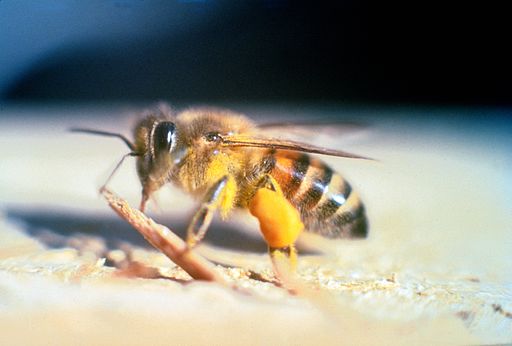
Africanized Honeybee
Attribution: Jeffrey W. Lotz, Florida Department of Agriculture and Consumer Services, Bugwood.org [CC-BY-3.0], via Wikimedia Commons
Size:
About 1/2-inch in length.
Color:
Golden-yellow with darker bands of brown. Some specimens appear a darker brown than others.
Behavior:
Africanized honeybees (AHB) are actually a subspecies of the European honeybee, and the two look exactly the same. Only an expert making numerous microscopic measurements can tell the two apart. The difference, however, becomes readily apparent in the aggressiveness of the AHB when its colony is disturbed, lending to its nickname “killer bees.” The AHB releases an alarm pheromone that calls all the workers to “battle” where they will attack and sting any moving animal or object. They will chase and sting people for hundreds of yards and have been known to sting people and pets over a whole neighborhood block. Deaths may occur due to allergic reactions from the larger number of stings received. It may take hours for the bees to settle down and return to the colony. Other honeybees will attack and sting for a few minutes and then settle down rather quickly.
In the United States, the AHB has become established from Texas over to southern California. Colonies have also been discovered in Florida and a few other southeastern states but these have been quickly eradicated. In the wild, honeybees most often nest inside cavities of trees, but they will also nest within caves and cracks in rock formations. Occasionally, a colony will decide to nest inside a crawl space, an attic, a wall void, or a chimney in a home.
Because the Africanized honeybee cannot be distinguished from its native cousins without detailed scientific measurements, any honeybee nest or swarm found in southwestern states should be respected at a safe distance. Only experienced beekeepers and/or pest management professionals should be contacted to deal with colonies or swarms of honeybees. Never attempt to treat such nests without the proper training and equipment. Once the colony inside a wall or attic has been eliminated, the building owner will need to open the wall and remove all the honey and honeycomb. If not removed, the honey will rot, produce strong odors and seeping stains, and will attract other insect pests.
Family Name:
Apis mellifera scutellata
Read What Our Clients
Are Saying
Mr. Carl Quick is my terminix at Morty Pride Meats. He is a wonderful person. He does a very good job. He is a respectful person and a friendly person. He is great. I would recommend him to anyone.
Very professional and through service
Very detail in his instructions and polite.
Ronaldo provides exceptional service. I recommend his customer service
Isaiah Langlais thank you, you always take care of our property when you come.
Very, very, very good customer service! Anthony Parker is a great representative and he is very well informed. I highly recommend!!!
Ronaldo Thomas did a great job. Thank you sir for taking your time and not rushing great service
Super friendly and dedicated to quality customer service!
Ronaldo (Thomas) was amazing! He goes above and beyond ever service!
Quenton, is a great technician did a thorough job.
Incredible customer service. Thorough and professional!
Ronoldo thomas was both courteous and professional he took care of the inside and the outside of our home he was friendly. He explained everything that he was doing, and he was respectful of both my home and my time.
SERVICE REQUEST?
Fill out the form below.