SERVICE REQUEST?
Fill out the form below.
Find our nearest location
Your Local Office

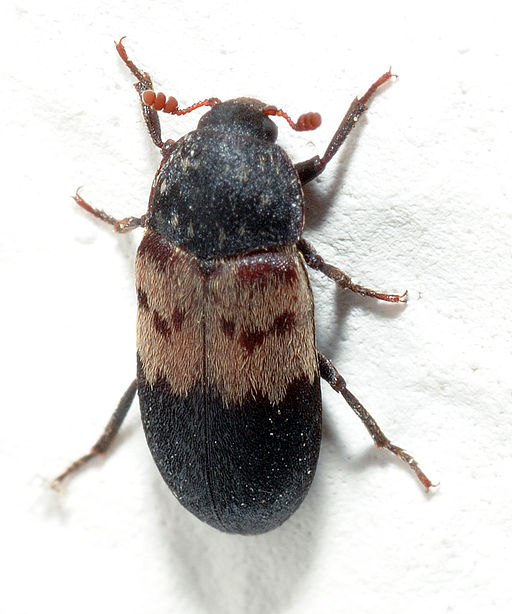
Larder Beetle
Attribution: André Karwath,[CC-BY-SA-2.5], via Wikimedia Commons
Size:
1/4 to 1/2 inch
Color:
Dark brown to black with pale, yellow six-spotted band across front half of wing covers. The underside and legs are covered with fine yellow hairs.
Behavior:
The genus name “Dermestes” comes from Greek and means “to devour a skin.” Adult larder beetles are often found outside overwintering in crevices of bark. In late spring or early summer, they may enter structures seeking a food source on which to deposit eggs. The eggs are generally laid directly on the food source although they may be deposited into nearby crevices. Egg laying lasts 2-3 months through the summer and a single female deposits as many as 200 to 800 eggs. The eggs hatch within 12 days and the larvae feed continuously on their food source, preferring those with some fat or oil content. They will, however, feed on dead cluster flies and other insects inside attics or walls. They may also be found in the dead insect accumulations in the bottom of insect light traps. Although larder beetle larvae are active and fairly agile, they become immobile if disturbed and “play possum” until the danger has passed. The larvae have strong mandibles and have been observed to bore into both hard and soft woods and even lead. Larvae molt up to six times before pupating. The mature larvae wander from the food source and may bore into anything in the immediate vicinity to find a site to pupate. The entire life cycle may be completed within 40 to 50 days under suitable conditions.
Larder beetles are common pests of many industrial, commercial sites where animal protein is processed or stored. They may be found in homes feeding on dead insects or a rodent or bird carcass inside walls, attics, crawlspaces and basements. Foods attacked include ham, bacon, meats, cheese, stored tobacco, dried fish and dried pet food as wells as hides, skin, bones and dead insects. These beetles may be used by museums to clean flesh and hides off animal skeletons.
The control of any stored product pest involves many steps, primary of which is discovery of infested food items or other sources of infestation (e.g., food spillage accumulation). The larder beetle will be associated with a moist protein source or accumulations of dead insects. A pest management professional can be helpful in finding difficult infestation sources. Once discovered, the source will need to be removed or a residual treatment applied into the void to kill the beetles and larvae feeding on the source.
Family Name:
Dermestes lardarius
Read What Our Clients
Are Saying
Zach H is the bomb! Great customer service! Handle my problem superior. I was freaking out I’m terrified of mice/rats and Zach made me comfortable and confident that Terminix will get the job done over all the other pest companies call “Zach Attack at Teminix!”👍🏾
Ronaldo Thomas did a great job. Thank you sir for taking your time and not rushing great service
Mr. Thomas was amazing! He explained everything that he was doing and was very nice.
Ronaldo (Thomas) was amazing! He goes above and beyond ever service!
Daniel MainsHe was very well informed and kind. Made the process easy and stress free.
Ronaldo provides exceptional service. I recommend his customer service
Incredible customer service. Thorough and professional!
Do you professional and his business quite well?nAnd very respectful of the property
Super friendly and dedicated to quality customer service!
Very satisfied with their service.
Very attentive work with excellent customer service and performance!
Quenton, is a great technician did a thorough job.
SERVICE REQUEST?
Fill out the form below.